The Iranologist
A new essay; the barbarian invasion; a Henry Corbin reading-guide.

I’m out in Hong Kong. I’m here for the month of March on a writing residency. It’s the kind of writing residency on which I’ve done next to no writing. Not much reading either. Plenty of eating, walking, drifting. Listening to war podcasts. I’ve never been to Hong Kong before: there’s a lot to see.
One thing I did write — or rather, one thing I edited, having written a rough draft in the days before I flew out of Dublin, when I had my books with me — is a long essay on the philosopher Henry Corbin. Yes that’s right, the same Henry Corbin I’ve been going on about this past year, the one who wrote penetratingly on the subject of Islamic mysticism. Henry Corbin, who introduced me to figures I’ve become enchanted by such as Ibn ‘Arabī, Suhrawardi, and the ‘immortal wanderer’ Khidir. The essay has just been published on Unherd — you can read it here.
If you’re writing about Henry Corbin, you’re inevitably writing about Iran - which means that my preoccupation with him has lately become all-too topical. As I discuss in the essay, Corbin lived in Tehran for a large part of his life and wrote several books about Iranian philosophy and spirituality. In a striking, apparent coincidence, my essay was published on Nowruz, the day of celebration for the Persian New Year.
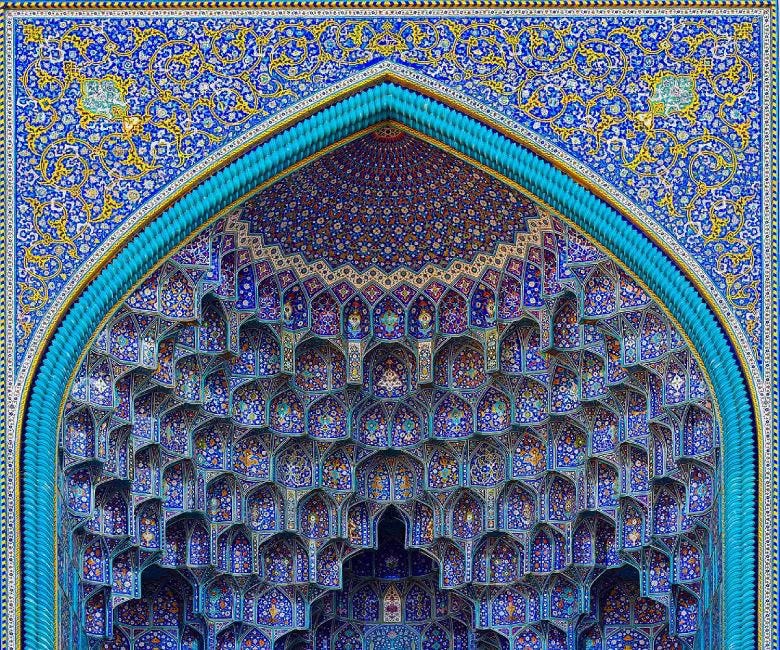
Last year, I bought a gorgeous, glossy, coffee-table type book titled Mosques: Splendours of Islam, which I’d first seen in a bookshop in Istanbul (it was too heavy to bring home in my luggage, so I later ordered it online). I’d been so enchanted by Istanbul’s mosques that, like a drug fiend, I wanted to chase the high, find out what other halfway comparably majestic mosques are to be found on this planet of ours and then go visit them if I could. Anyway, on the cover of that book is a remarkably beautiful image of the dazzling, intricate, lapis-turquoise interior of the Imam Mosque in the Iranian city of Isfahan. It looks a little like a DMT trip — which affirms my feeling that Islam’s theology, architecture, geometry and so on is deeply psychedelic. Like disciplined psychonauts who use dhikr (‘the remembrance of God’ through continuous prayer) rather than hallucinogens or dissociatives, Islam’s sages have made a science of mapping out the interior cosmos, unveiling the hidden and sublime architectures of the Real. I don’t know if there’s any other major religion where you can devote yourself to the study of ‘theoretical mysticism’.
I’ve wanted to visit the Isfahan mosque ever since seeing it on that book cover. But if that seemed like a distant dream a year ago, what with Iran’s hardline theocratic regime and its missile exchanges with Israel, today, with Iran being bombarded amidst outright war, I don’t know if I’ll ever get the opportunity to see for myself the mosques of Isfahan. In fact, it’s uncertain whether they’ll even survive. An article recently appeared in the Guardian about how American and Israeli bombing has already damaged heritage sites across Iran, including the 17th century Chehel Sotoon Palace in Isfahan. The article reports ‘major explosions in the centre of Isfahan, Iran’s capital in three historical eras, where much of the architecture dates back to the Safavid dynasty era, from the 16th to 18th centuries.’ Reading the article made me think that bombing Isfahan is like bombing Seville, or Lisbon, or some other delicate city of precious, intricate historical loveliness and sacred architectural treasures. It goes on:
‘Chehel Sotoon suffered the worst impact but broken windows and doors, as well as dislodged tilework, have been reported in the Ali Qapu Palace and several mosques around the vast Naqsh-e Jahan Square. Videos filmed by residents from inside the square showed plumes of smoke rising from nearby airstrikes.
‘The Isfahan governor, Mehdi Jamalinejad, said the damage had been inflicted even after coordinates of the historic sites had been circulated among the warring parties and after blue shield signs – denoting historical treasures under the 1954 Hague Convention for the protection of cultural objects in war – had been put on the roofs of important buildings.
‘“Isfahan is not an ordinary city, it’s a museum without a roof,” Jamalinejad said in a speech posted on social media. “In none of the previous eras, not in the Afghan wars, not in the Moghul conquest, not even during the ‘sacred defence’ [the 1980-88 Iran-Iraq war] was this ever done.”
‘“This is a declaration of war on a civilisation,” he added. “An enemy that has no culture pays no heed to symbols of culture. A country that has no history has no respect for signs of history. A country that has no identity sets no value for identity.”’
So, I won’t be visiting Iran any time soon. Bt least I can still read Henry Corbin, Seyyed Hossein Nasr and their colleagues, and travel in the imagination to the Persian interworld of mystical enigmas and metaphysical images. As ‘bonus content’ to my essay about Corbin, I thought I’d include here a brief guide to some of his major books.
Alone With the Alone: Creative Imagination in the Sufism of Ibn ‘Arabī
This is definitely a good place to start with Henry Corbin. It’s where I started, and it’s one of several books in which Corbin goes deep on his key concept of the mundus imaginalis or imaginal world. Alone With the Alone familiarises you as you go with Corbin’s strange, exotic vocabulary and universe. He includes a short biography of Ibn ‘Arabī, so we get to travel from the Shaykh al-Akbar’s native Andalusia (Seville, Cordoba, Granada — some of the most gorgeous places in Europe) to the Islamic East of the twelfth and thirteenth centuries. (Ibn ‘Arabī was a great traveller, a wayfarer in fact as well as in thought, and he even wrote a book titled The Secrets of Voyaging.) In his very interesting introduction to this book, Harold Bloom writes of Corbin that ‘He was uniquely equipped not only to recover Iranian Sufism for the West, but also to defend the principal Western traditions of esoteric spirituality.’ When I read Alone With the Alone it was as if I’d discovered some wild, truly out-there, hyper-Borgesian form of advanced speculative fiction. Profound and amazing.
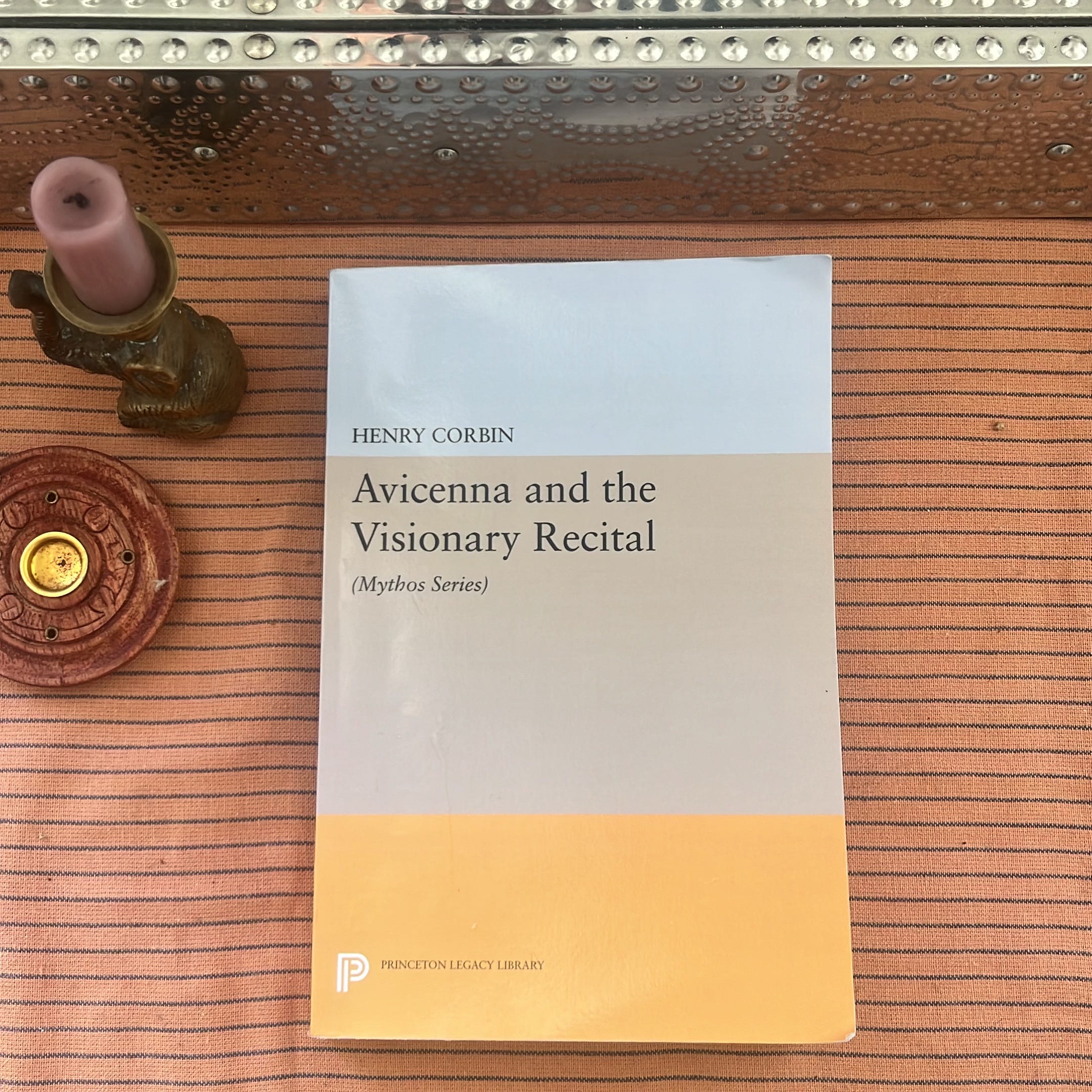
Avicenna and the Visionary Recital
Avicenna (also known as Ibn Sina) was a famous Persian philosopher, but in this book Corbin focuses on his lesser acknowledged gnostic, mystical side. This one is also a good way to get into Corbin’s world, even if you’re not familiar with Avicenna or his work. Again, the notion of an ontologically real ‘interworld’ of metaphysical images — the imaginal world, that which the Sufis call alam al-mithal — is central. Corbin’s book is based around three symbolic-mystical ‘recitals’ written by Avicenna, of which Corbin provides full translations. As such, it’s accessible, absorbing, and fascinating.
Spiritual Body and Celestial Earth: From Mazdean Iran to Shī’ite Iran
This one took me ages to read, but it’s essential and marvellous. Corbin is never dry — his language is gorgeous, evocative, mysterious, ethereal, like you’re wandering through some ancient underground mountain-hallway in a dreamscape — but his writing in this book and others is dense and demanding. I read him with a pen in my hand and I underline a lot. Once again, and in fact more so than the previous books, this one really gets into the intricacies of the alam al-mithal, the imaginal world. The first half of the book is given over to Corbin’s wild-style philosophising about the interworld, the afterlife, the profoundest meanings of mystical experience, and so on; the second half comprises his translations of texts by a dozen or so of Islam’s most influential and revelatory mystical philosophers, including Suhrawardi (a fascinating figure, about whom I urge you to learn more — this episode of the excellent ‘Let’s Talk Religion’ podcast is a good place to start), Ibn ‘Arabī, Mulla Sadra, and others. It’s a life-enhancing book: in his strange and singular way Corbin is a remakably hopeful writer. In some ways he’s the inverse and antidote to the great comedian-aphorist of metaphysical nihilism, E.M. Cioran, who — amazingly! — I learned was a friend of Henry and Stella Corbin. The three of them used to enjoy companionable dinners together at the Corbins’ apartment in Paris. Imagine! I’ve just skimmed the Goodreads page for Spiritual Body and Celestial Earth and noticed this charming, accurate, two-sentence review by a young woman named Misam: ‘Truly magnificent and brilliant. Despite the complexity covered, Corbin writing is digestible, spiritually revitalising and mentally stimulating beyond measure.’
The Man of Light in Iranian Sufism
This later book is shorter than Corbin’s other major books and, although it’s relatively well-known, in my view it’s a more taxing and slightly less satisfying read than the others. And yet I still very much recommend it, because it’s full of deep insights into mysticism, gnosis and, in particular, the idea, which Corbin traces across ancient Persian religions such as Manicheism and Zoroastrianism as well as mystical Islam, of a ‘heavenly witness’, a kind of higher self who for each of us is our representative in the higher, invisible world, so that the inner and spiritual life becomes a kind of dialogue, a mutual journeying-towards and consummation between these two poles of our ‘bi-unitary’ being. He also explores Sufi theories about the coloured photisms of variously coloured lights that appear to mystics when they attain distinct stations or levels on the inner Way. In this as in all of his books, Corbin says things that astonish me, things that would seem like the utterances of a madman if it weren’t the case that Corbin is so evidently sane, and not just sane but formidable.

The Voyage and the Messenger: Iran and Philosophy
This one is more hit and miss: it’s a collection of essays and speeches given by Corbin at conferences and ceremonies throughout his career. Some of them are quite niche, relating to, for instance, debates within academia about the nature and parameters of the field of ‘Iranology’; a historical account of the emerge of comparative religion as a field of study, and so on. But other essays, particularly the ones on Corbin’s abiding philosophical-mystical concerns and the implications of the visionary traditions of East and West, are typically interesting.
History of Islamic Philosophy
This one is not the kind of book you’d likely read straight through; it’s more a work of reference that offers an encyclopaedic overview of the evolution of Islamic philosophy from the time of the Prophet Mohammad, across the various schools of Sunni and Shia, with of course plenty of Sufism. It’s worth owning a copy of this one.
Sadly, no biography has yet been written of Henry Corbin (although a first edited collection in English of scholarly essays about him was published last year, which I’ve yet to read). So, to round off my inundation of Corbin-content, here’s a lovely and illuminating biographical sketch on YouTube by the American Corbin scholar Tom Cheetham.
See you in the barzakh.
I was not aware of Corbin or his work until reading your hosannas of him, Rob. So I'll definitely be looking into him in the near future. Iran and its formidably rich history has long fascinated me, and, given the dire straits it is now in, my hopes of one day visiting it and seeing its splendour firsthand have been similarly dashed. However, as you say, visiting it via the imagination and Corbin's work remains an option, thankfully.
Thanks so much for this. I have had a lifelong connection tot Tibet.